Sleep tracking with just your phone
No wearable, no account, free. Leave it on the nightstand and wake up to a clear picture of your night.
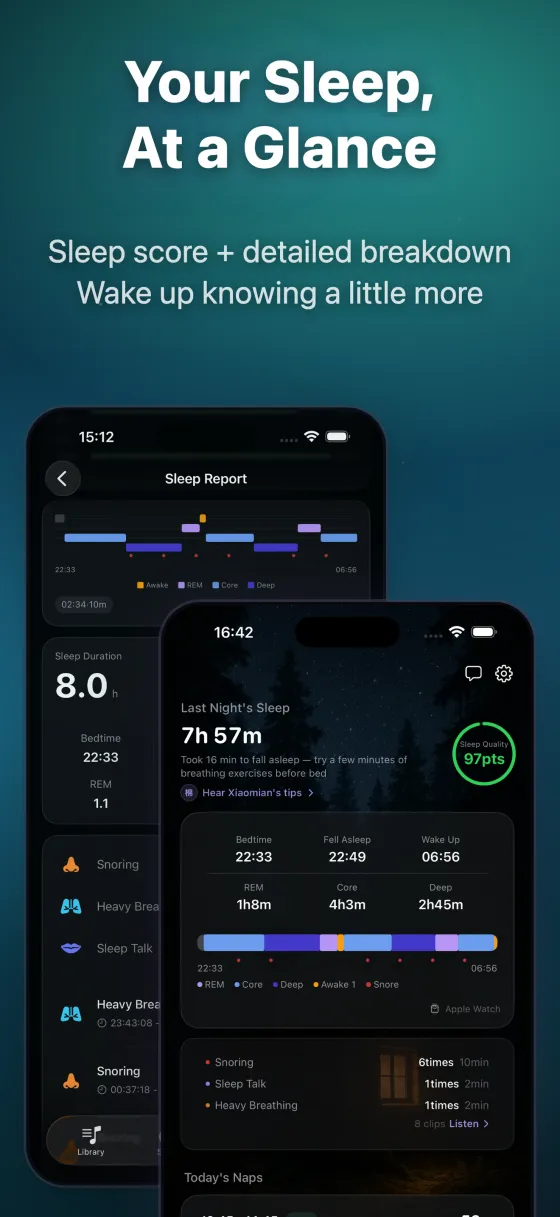
Most accurate sleep trackers need a watch you have to wear and charge every day. Sleep Island uses your phone’s own motion sensors — leave it on the bed or nightstand and it records the whole night. Nothing on your wrist, no extra device to buy.
How it works
It samples movement all night
Your phone’s accelerometer records your body movement at a constant rate. Collection itself is cheap on battery — the heavy math is saved for the end.
It compiles the whole night at once
After you stop, an on-device engine analyzes the entire night in one pass — using actigraphy (Cole-Kripke, the movement-based method sleep researchers have used since the 1990s) plus a statistical model (an HMM) to reconstruct when you were awake, asleep, light vs deep.
It calibrates to you each night
It builds a per-night baseline from your own data instead of applying one-size-fits-all thresholds — so it adapts to you rather than to an average sleeper.
What you get
- Time to fall asleep, wake-ups, total time asleep
- A full-night awake / asleep timeline
- A light- vs deep-sleep estimate
- Snore and sleep-talk recordings (reviewable separately)
- A short AI summary of your night
What it can and can’t do (we say it straight)
Telling whether you’re asleep at all is something a phone does well — in our own testing against an Apple Watch, sleep-vs-wake agreed about 95% of the time. But staging (light/deep) is an estimate inferred from movement: a watch that reads your heart rate is more precise, and we won’t pretend otherwise. We don’t report REM on the phone at all — an accelerometer can’t see it, so rather than invent one we give you 4 honest stages instead of 5 with a guessed one. If you need precise staging, a Watch genuinely beats this.
Why the sound stops right after you fall asleep
Because it knows you actually fell asleep. The ambient sound doesn’t stop on a fixed timer — a timer either cuts out while you’re still awake (and the sudden silence wakes you) or runs all night, draining battery and tiring your ears. Sleep Island stops only after it detects sleep plus about 10 quiet minutes. The failure mode is “stops a little late,” never “stops while you’re still awake.”
Privacy
No account, no login — the only identifier is an anonymized device ID. Your snore and sleep-talk recordings stay on your phone and are never uploaded. To keep improving the model, only anonymized, minute-level motion features are sent — so it is not “fully offline,” and we say that plainly rather than pretend nothing leaves.
FAQ
Do I need a smartwatch to track sleep?
No. Sleep Island uses only your phone’s motion sensors — nothing on your wrist and no extra device to buy.
How accurate is it compared to an Apple Watch?
Sleep-vs-wake agreed about 95% of the time in our testing. Staging (light/deep) is an estimate and a heart-rate watch is more precise; we don’t report REM on phone. For precise staging a Watch is better — but for understanding your sleep day to day, the phone is plenty.
Does it drain my battery overnight?
It’s designed to be light: cheap sensor collection runs overnight, and the heavy analysis runs just once in the morning rather than continuously through the night.
Is it really free? What’s the catch?
The core is free — no subscription, no 7-day trial, no account. The one honest caveat: anonymized motion features upload to improve the model.